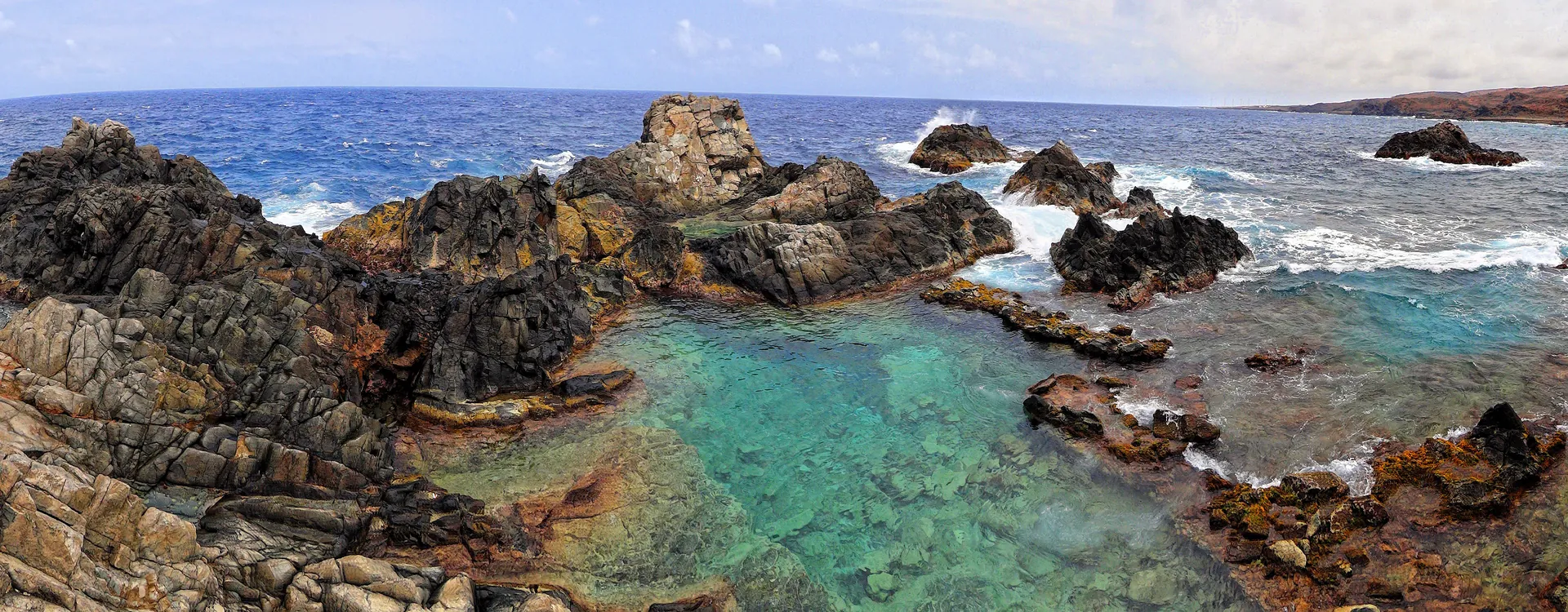
The last hundred metres down to Conchi is a scramble over loose coral and dark volcanic rock, and you hear the Atlantic before you see it: a low, steady thump, as if somebody is hitting a mattress with a cricket bat. Then the pool appears below, a circle of green-blue water ringed by jagged stone, with white spray shooting over the seaward rim every few seconds. I have made that descent more times than I can count, and the first step in still takes my breath away. It is cold, properly cold, after the heat of the rock.
That mix of reward and risk is the whole story of swimming here. People arrive expecting a swimming pool with a view. What they find is a tidal basin on the wildest coast of Aruba, and the difference matters more than most holiday photos let on.
What Conchi Actually Is
Conchi is Papiamento for shell, or conch, and the name fits: a bowl of stone on the windward shore, cut into the volcanic rock inside Arikok National Park. There is no sand shelf to wade into and no lagoon behind it. The basin fills and drains with the North Atlantic, which is why the water is cooler and clearer than anything you will find on the hotel side of the island.
The Aruba National Park Foundation manages the park and posts current notices and closures, so check arubanationalpark.org before you set out. Rangers shut the access road when the sea is running, and they do not negotiate.
Can You Swim in the Natural Pool in Aruba? The Short Answer
Yes, on a calm day, with shoes on your feet and a reasonable level of comfort in open water. That is the honest version. The full version takes in swell, tide, entry conditions, and the fact that access can close without much warning.
What the basin is not is a managed pool. Nobody tests the water, nobody sweeps the floor, and nobody is watching from a tower. It is a hole in the coastline that the ocean happens to fill, and it behaves accordingly.
My rule is simple: if you can hear the surf from the car park above, the swell is already too big for a relaxed swim. Go and look from the rim, take your photos, and come back another morning.
Depth and Swimming Conditions at Conchi
How Deep Is the Natural Pool?
On a normal tide the basin runs from ankle deep at the rim to roughly three metres at its deepest point near the seaward edge. Most adults can stand in the middle with their head clear. Small children cannot, and the floor drops away faster than it looks from above. Sand shifts with every storm, so a depth quoted in an old blog post may be a foot out by the time you visit.
Fresh water does not feed Conchi. It is sea water, replenished through a low channel and over the rim, which keeps it clean and also means the level rises and falls with the ocean outside.
Temperature and Clarity
Expect around 26 to 28°C (79 to 82°F) year round, a touch cooler than the resort beaches because the Atlantic side catches the upwelling and the breeze. On a windy morning it feels bracing. On a still afternoon it is close to bath water, which is when most people linger far longer than they meant to.
Visibility is usually excellent, and you can see the bottom and the rock walls clearly. That helps with judging depth. It also shows you the sea urchins you would rather avoid.
| Zone | Typical Depth | What It Means for You |
|---|---|---|
| Rim shelf | 30 to 60 cm | Where most people stand; the slipperiest rock in the pool |
| Mid basin | 1.5 to 2 m | Comfortable for adults who can tread water |
| Seaward pocket | Up to 3 m at high tide | Strongest surge; skip it when the swell is up |
Depth is only half the question. The other half is whether you can get in and out without hurting yourself, which is where the entry matters more than the water ever does.
The Entry, the Surge and the Currents
Rock, Not Sand
You do not walk into Conchi, you climb in. The descent runs over boulders and coral rubble, then slick volcanic ledges, and the last few steps are usually wet. Sea urchins sit in the shaded crevices, and they sit in separate little colonies, so a bare foot is a bad idea anywhere near the water.
Water shoes or strappy sandals with grip handle this fine. Flip flops do not. The ledge that catches most people is the one closest to the water, and there is no handrail to grab onto.
Surge, Splash and Current
Conchi is sheltered, not sealed. Waves break over the outer rim and dump into the basin, and the water inside pulses back and forth like a slow tide. On a calm day that pulse is gentle and pleasant. On a rough day it can push a swimmer against the rock wall within a couple of seconds.
There is no rip current in the open-beach sense, because there is nowhere for the water to run. The real force is the surge itself, plus the splash over the rim that knocks people off balance on the ledge.
Where People Actually Get Hurt
- Slipping on wet rock at the entry, usually with hands full of phone or camera.
- Standing on a sea urchin while barefoot, most often near the shaded edge of the basin.
- Getting pushed into the wall by surge after swimming out towards the seaward side.
- Cut feet and grazes from coral rubble on the climb back up, when legs are tired and the sun is high.
Take the climb down slowly and leave one hand free. I have watched a dozen people drop a phone into Conchi, and I have never once seen anyone get it back.
Best Tide, Weather and Who Should Stay Dry
The Window That Works
Low to mid tide with a light wind from the east or southeast is the nicest combination. The rocks dry a little, the surge eases, and the shelf near the rim gives you a safe place to sit. Early morning beats midday for temperature and for crowds, and it also gives you the calmest water before the trade winds build.
Anything from December through March can bring a long-period swell rolling in from the North Atlantic, and that is when the pool turns into a washing machine. Hurricane season, June to November, brings its own swells from storms hundreds of miles away. The National Hurricane Center is worth a glance, and regional sea-state data from CariCOOS tells you what the water is doing offshore.
Who Should Skip the Swim
Conchi is not a place for weak swimmers, unsupervised children, or anyone who needs a handrail and an even surface to get in. The floor is uneven, the entry is a scramble, and nobody is on duty if something goes wrong.
- Children who cannot swim unaided, and any child without an adult within arm’s reach.
- Anyone with knee or hip problems, or poor balance, given the boulder descent.
- Swimmers who are not confident treading water in two metres or more.
- Anyone with an open cut or graze, because the water is untreated and coral scrapes infect easily.
- Anyone who has been drinking. The drive out is rough and the entry is unforgiving.
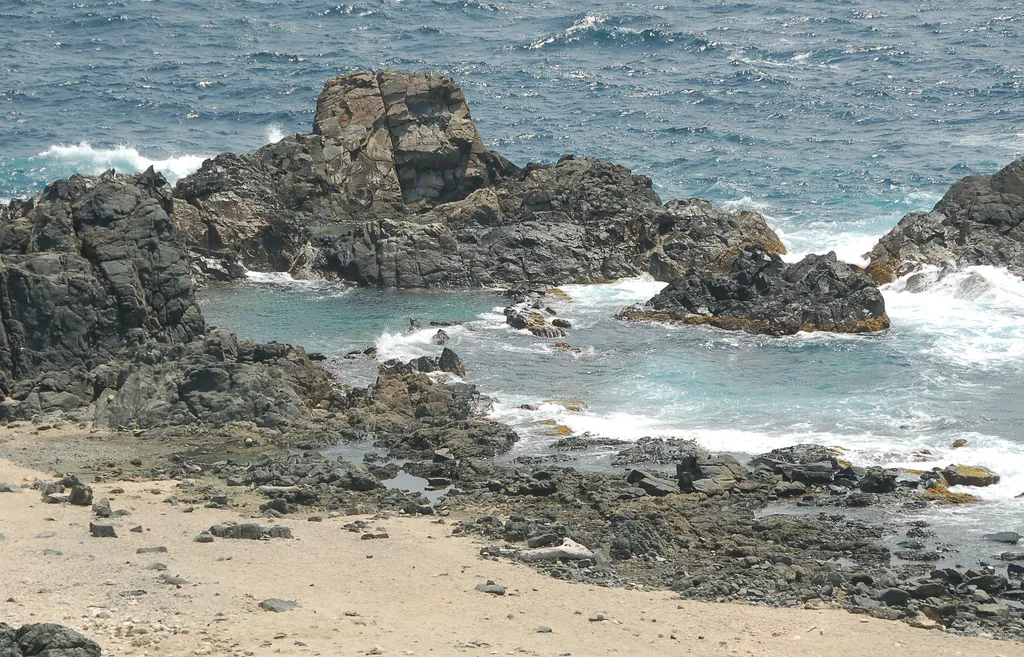
Wind direction matters more than the forecast number on your phone. A steady 15 knot easterly is fine at Conchi. A windless day after a north swell is not, because the water has nowhere to go and the surge just sits and heaves inside the basin.
Conchi rewards patience. Pick your morning, watch the sea for ten minutes before you commit, and the swim is one of the best on the island.
No Lifeguard, No Supervision: What That Means in Practice
There is no lifeguard at Conchi and no rescue station within sight of it. Mobile signal is patchy inside the park, strongest near the visitor centre and unreliable in the deeper valleys between the hills. If someone gets into trouble, help comes from park rangers first and then from the coast road, which is a long way from a rock basin in the middle of Arikok.
That changes how you behave in the water. Swim with a partner who is watching you instead of taking photos. Keep the group small enough that you can count heads without thinking. Set a time to get out and stick to it, because wind and sun both tire you faster than you expect.
Emergency numbers for the island are published by the Government of Aruba, and 911 works from any phone with a signal. If you would rather swim somewhere with supervision, the calm west-coast beaches are listed on the Aruba Tourism Authority site.
Snorkelling, Visibility and What You Will See
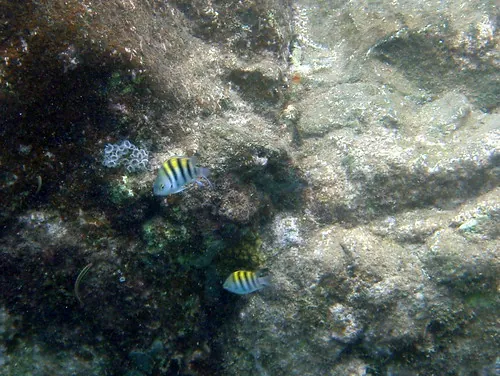
Conchi is a pleasant snorkel on a still morning and a waste of a mask after a swell. Sergeants, small parrotfish, wrasses and the odd juvenile barracuda drift through the basin, and the rock walls carry a thin skin of coral and sponge. It is not a reef dive site and nobody should plan a trip around the underwater life here. Sand churn after heavy weather cuts visibility to a metre or two, and the surge makes mask work frustrating.
Bring a mask only if you already own one. Snorkel gear rented on Palm Beach is bulky on the descent, and the boulder scramble at the bottom is no place for a long fin.
Sun, Heat and Dehydration on the Rock
There is no shade anywhere around the pool. The rock is dark volcanic stone and it radiates heat straight back at you, so the temperature on the ledge can feel ten degrees hotter than the car park above. Most visitors underestimate the climb back up, and it is the return leg where people start to flag.
- Swim before 10am or after 3pm, and avoid the midday stretch entirely in summer.
- Drink from your bottle before you feel thirsty. Dehydration creeps up on the rock.
- Wear a hat on the descent and back up, even if you leave it on a boulder while you swim.
- Keep a spare shirt in the car. Salt and sweat together make the drive home unpleasant.
Etiquette and Leave No Trace at the Pool
The basin is small, and twenty people make it feel crowded. A few habits keep it decent for everyone. Apply reef-safe sunscreen at least twenty minutes before you get in, so the water does not carry it away. Move off the entry ledge once you are out, because that is where the next person is trying to find a foothold. Skip the cliff jumping; the water is shallower than it looks from the rim and the rocks below are unforgiving.
- No glass, no single-use plastic, and nothing left behind. Pack out every wrapper.
- Drones are not permitted in Arikok National Park without a permit from the park authority.
- Do not touch or move marine life, and do not stand on coral to steady yourself.
- Keep voices down when others are swimming. Sound carries oddly off the rock walls.
Practical Prep Before You Swim
- Water shoes with grip, not flip flops. This is the single most useful thing you can bring.
- Two litres of water per person, more if you are walking in from the trailhead.
- Reef-safe SPF 50 and a hat. There is no shade on the rocks at all.
- A small first aid kit with antiseptic and plasters for coral grazes.
- A dry bag for your phone. Salt water kills electronics faster than sand does.
- A tether for your GoPro, because a dropped camera in a tidal basin is gone for good.
Park regulations, drone restrictions and the separate Cave Pool closure are covered in our visitor rules and safety guide. If you are still deciding how to get here, the transport hub compares the 4×4, ATV and hiking options, and the costs page breaks down the Arikok entrance fee and what a guided day really adds up to.
Swimming at Conchi: FAQ
Can you swim in the Natural Pool in Aruba?
Yes, on a calm day, and it is worth the effort. The water is clean and genuinely refreshing, and the basin is sheltered enough for a relaxed swim when the swell is low. It is not a managed pool though: there is no lifeguard, the entry is over wet rock, and access closes when conditions turn rough.
How deep is the Natural Pool (Conchi)?
Between roughly 30 cm and 3 metres, depending on the tide and where you stand. The rim shelf is ankle to knee deep, the middle sits around 1.5 to 2 metres, and the deepest pocket near the seaward edge reaches about 3 metres at high water. Storms move the sand, so treat any figure as a guide rather than a fixed number.
Is there a lifeguard at Conchi?
No. There is no lifeguard, no rescue board and no supervision of any kind. Mobile signal is unreliable in the park, and the nearest professional help comes from rangers and then from the coast road. Swim within your ability and keep an eye on everyone in your group.
What is the best time of day and tide to swim at Conchi?
Low to mid tide, early morning, with light east or southeast wind. Arrive before 10am for calmer water and fewer people, and check the sea from the rim before you climb down. Early December through March carries the biggest north swell risk, so build a backup day into your itinerary.
Do you need water shoes for the Natural Pool?
Yes, and do not debate it. The entry is boulder and coral rubble with wet volcanic ledges, and sea urchins sit in the shaded crevices. Water shoes or grippy sandals cost very little and prevent the injury that ruins a holiday. Flip flops slip off on the descent and are worse than bare feet.
Can you swim at Conchi when the swell is up?
No, and the park will usually stop you anyway. When long-period swell hits the windward coast, waves break over the outer rim and surge pushes swimmers into the rock walls. Rangers close the access road in those conditions. If you arrive and find it shut, take the ridge viewpoint instead and try again the next morning.
Can you swim in the ocean in Aruba?
Yes, and on the west and south coasts it is easy, calm and warm for most of the year. The resort beaches suit families and nervous swimmers because the water is shallow and sheltered from the Atlantic swell. The east coast, where Conchi sits, is a different animal entirely. Match the coast to the swimmer, not the other way round.
Is the Natural Pool safe for children?
Only for confident swimmers aged roughly ten and up who have an adult within arm’s reach at all times. The rim shelf is shallow but the floor drops to two metres within a few steps, the entry is a wet boulder scramble, and no lifeguard is on duty. Younger children are safer on the west-coast beaches, where the water is flat and help is nearby.
Do you have to pay to swim at the Natural Pool?
Swimming itself is free, but you pay the Arikok National Park entrance at the gate, roughly US$11 to $15 (about €10 to €14) per adult, with children and residents at reduced rates. Check the current fee on the official park site before you drive out, because rates change and the gate takes card as well as cash.
Once you have swum, walk up to the ridge and look back down. Our photo spots guide has the angles that work, and the reviews hub tells you what other visitors say about crowding and road conditions. The hike page covers the walk in if you would rather arrive on foot, and the 4×4 and parking guide sorts out the tumble-dryer ride to the trailhead.